
Emotional Identification Difficulty
You know something is happening internally but can’t name it. Therapy helps you build the vocabulary and awareness that socialization didn’t.
Normative Male Alexithymia · Tigard, Oregon & Online
Many men feel things deeply — they just can’t get those feelings into words. That’s not a character flaw. It’s a pattern called normative male alexithymia (NMA), and it develops through decades of socialization that discourages boys from building emotional awareness. At Discover Counseling, we help men close that gap — and reconnect with themselves and the people they care about most.
Questions? Read our FAQs · View our fees
You might be here because
What is normative male alexithymia?
Alexithymia literally means “without words for emotions.” Clinical alexithymia is a neurological condition. Normative male alexithymia is something different — and far more common.
Coined by psychologist Ronald Levant, EdD — a former president of the American Psychological Association — normative male alexithymia describes a learned, socialization-driven pattern in which men develop limited access to their emotional experience. Not because they lack emotions, but because they were systematically taught not to attend to them.
Boys who are discouraged from expressing vulnerability, told to “shake it off,” or praised only for toughness grow into men who genuinely struggle to identify what they’re feeling — even when the emotional signal is strong. Feelings may register physically without ever becoming conscious awareness. Stress shows up as irritability or withdrawal, not as “I’m overwhelmed.” Anxiety becomes restlessness or overworking, not “I’m scared.”
This is not a character flaw. It is not emotional weakness. It is a gap — and gaps can be closed.
What we work with
You know something is happening internally but can’t name it. Therapy helps you build the vocabulary and awareness that socialization didn’t.
Emotions register physically — tension, numbness, restlessness — but don’t translate into words or awareness. Somatic approaches like Brainspotting are particularly effective here.
You care deeply about your partner but struggle to show up emotionally in the ways that feel most important to them. NMA work often significantly changes relational dynamics.
You go blank, withdraw, or disengage during emotional conversations — not because you don’t care, but because the nervous system has no map for what to do next.
Expressing emotion feels dangerous or humiliating — a message that was reinforced early and often. IFS and ACT can help dismantle the belief that feeling is weakness.
When emotional shutdown began as a survival strategy in childhood, the path forward often involves both NMA work and trauma processing.
Our approach
NMA therapy isn’t about manufacturing emotions or pressure-testing your capacity to cry. It’s about building access to what’s already there — so you can use it, understand it, and communicate it when it matters. Rob works with modalities that are particularly well-suited to men who feel things in their bodies before they feel them anywhere else.
Parts-based
IFS works with the different “parts” of your inner experience — including the parts that learned to shut down feeling as a form of protection. For many men, emotional numbness was once adaptive. IFS helps those protective parts relax without abandoning their job.
Values-based
ACT builds psychological flexibility — the ability to feel what you feel without being controlled by it or running from it. For men with NMA, ACT is particularly effective because it anchors emotional work in values and action, not just insight.
Trauma-specific
When emotional shutdown is tied to painful early experiences or shame, EMDR can process those memories without requiring extensive verbal articulation. Especially useful for men who feel more than they can say.
Body-based
Brainspotting locates and processes emotional experience through the body and eye position — without requiring you to verbalize what you’re feeling first. For men with alexithymia, this is often the entry point that makes the rest of the work possible.
Who treats NMA at Discover Counseling

Registered Associate
Normative male alexithymia, shame, trauma, betrayal recovery. EMDR, Brainspotting, IFS, ACT. Men’s emotional awareness specialist.
View profile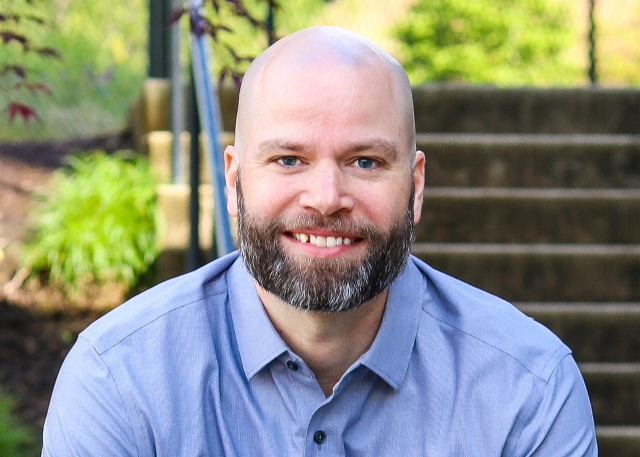
LPC
Anxiety, burnout, men’s issues, life transitions. CBT and trauma-informed care.
View profileNot sure who’s the right fit? Contact us — we’ll help you figure it out.
That’s actually the whole point of this work — you don’t need to arrive good at talking about feelings. Rob specializes in men who aren’t, and he uses approaches like Brainspotting and EMDR that don’t require verbal fluency to work. Many men who come in deeply skeptical find that what they thought was a personality trait turns out to be a learned pattern — one that can change.
It’s not a DSM diagnosis — it’s a well-researched psychological construct, documented in the APA Dictionary of Psychology and developed by Ronald Levant, a former APA president. You don’t need a diagnosis to benefit from this work. If the description fits your experience, that’s enough.
The goal isn’t to turn up the volume. It’s to build access — to know what you’re feeling, to be able to communicate it when you want to, and to stop being hijacked by emotions you can’t identify or manage. Men who do this work typically feel more grounded and in control, not less.
You don’t need to be convinced in advance. Many men come in with significant skepticism and find something genuinely useful — not because they were sold on a concept, but because they started noticing real patterns in their own experience. A first session is just a conversation. It doesn’t commit you to anything.
People have genuinely different emotional temperaments — that’s real. But NMA is specifically about difficulty identifying and describing emotions, not just having fewer of them. If you feel things physically without being able to name them, if you shut down under emotional pressure without knowing why, or if your emotional life is less accessible to you than you’d like — that’s NMA territory, not just personality.
It depends on what you’re working toward. Some men see meaningful shifts in 10–15 sessions. Others are working through deeper patterns — shame, trauma, or years of practiced shutdown — and want more time. Rob will discuss realistic expectations with you early on and adjust as you go.
Ready when you are
Reaching out doesn’t commit you to anything. We’ll respond within one business day — usually with a short reply and an invitation to schedule a free 15-minute consultation with Rob to see if it’s a good fit.
Questions? Read our FAQs · View fees & insurance